Soft Sculpture, Hard Politics at Frieze Los Angeles
On view at Frieze Los Angeles from Feb. 26 to March 1, 2026, Margarita Cabrera’s “Space in Between” filled Jane Lombard Gallery’s booth with soft sculptures of desert plants. Each form began with a U.S. Border Patrol uniform and ended as a saguaro or prickly pear, sewn in community workshops. The installation situated immigration policy within a living ecosystem. Cabrera reflects on transformation, care and collective authorship.

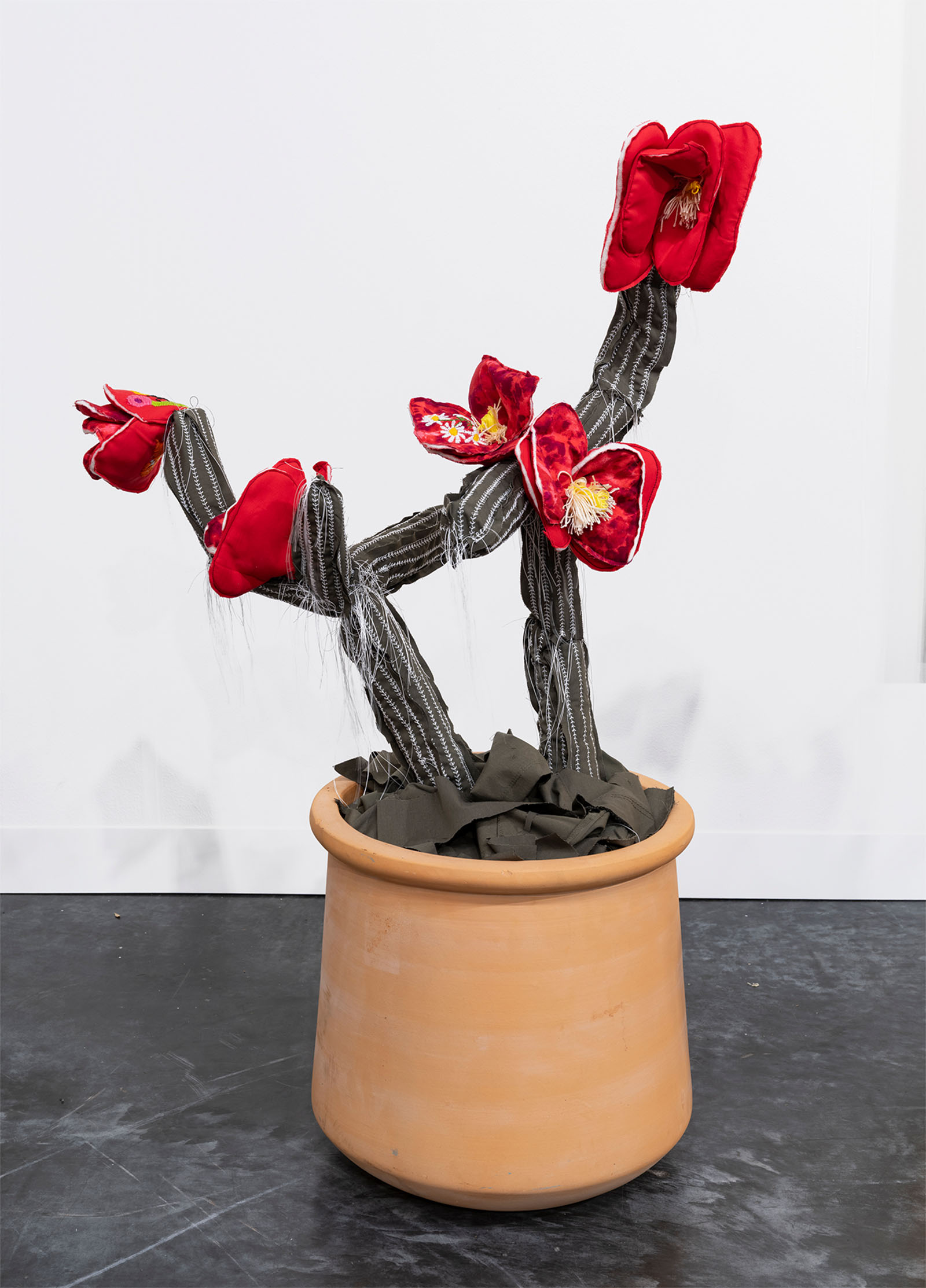
“Space in Between – Nopal,” in collaboration with M.R.S., 2016
U.S. Border Patrol uniform fabric, copper wire, PVC pipe, foam, thread and terra cotta pot, 42 × 40 × 11 in.
Courtesy of the artist and Jane Lombard Gallery.

“Space in Between – Bisnaga,” in collaboration with J.D. (Mexico/USA), 2016
U.S. Border Patrol uniform fabric, copper wire, PVC pipe, foam, thread and terra cotta pot, 50 × 18 × 18 in.
Courtesy of the artist and Jane Lombard Gallery.
Your work often begins with U.S. border officer uniforms and ends as indigenous desert plants. What does the shift from fabric that’s no longer “worn” but “grown” mean to you?
Margarita Cabrera: “The Space in Between” project centers the resilience of the desert landscape as cacti are able to survive and thrive in the most extreme and harsh of environments.
The main material of the “Space in Between” project is the border patrol uniform fabric which functions as a symbol of power and control representing violence, family separation, deportation, and death. The deconstruction of the uniform as a power symbol is cathartic for the participants who experience a strong emotional release as they cut through uniform leg seams, zippers, linings, and more and collectively construct new landscapes of belonging and care where all individuals have the right to a dignified life and self-determination.
Embroidery as a textile artform exists as a live archive, a form of memory.
In many works, the pockets, seams, patches, and labels remain visible. What do you want the viewer to recognize once they notice those remnants?
MC: The soft sculptures’ anthropomorphic shapes are presented as a new landscape meant to physically engage the viewer in a discovery of uniform elements. The various life-size sculptural saguaros, prickly pears, and agaves, invite viewers to literally move about the existing clustered landscape in an investigative mode much like the antagonistic role of an ICE officer “hunting” for bodies. On the other hand, I see the soft image of a power/military symbol simultaneously implies that new forms are possible, and that we are capable of transforming elements of violence into artistic elements of hope.
The stitched imagery and text feel like both ornament and evidence. How do you think about embroidery in your practice?
MC: Embroidery as a textile artform exists as a live archive, a form of memory. Inscribed epistemology of creating/making and imagining futurity. Sewing with colorful threads is a form of resistance where each thread protects the stories of communities that refuse to be erased.
You’ve worked with immigrant seamstresses and community workshop participants whose contributions carry specific personal histories. How do you structure collaboration, so it stays ethical and reciprocal rather than extractive?
MC: “Space in Between” communities are volunteer participants from various immigrant communities from Latin American countries and others abroad. We do not work with seamstresses. The workshops are rooted in ethics of care, collective decision making, active listening, relationship building, sharing resources and profits through donations. Participating communities and supporting partnering cultural institutions, and galleries recognize that we are all part of an immigrant community of cultural makers whose stories should be part of the cultural dialogues taking place in museums and institutions in the United States.
There’s a tension between softness (fabric, thread) and the hard realities you’re addressing, such as migration policy, labor conditions, violence, belonging. What can softness do, politically, that harder materials can’t?
MC: Traditional soft textile forms such as sewing, and embroidery can challenge rigid and harsh patriarchal colonial structures that marginalize immigrant communities by subverting craft technologies as tools for resistance, protest, and protection.
The border often gets reduced to a line or a wall, but your installations read as a living ecosystem. When you build a “landscape,” what histories are you trying to make present inside it?
MC: Our natural ecosystems have been scarred by a steel border wall restricting the movement and survival of all life forms.
“Space in Between” depicts a desert landscape that embodies ancestral knowledge, a wisdom that transcends borders and shapes the geographical, cultural and spiritual collective identity of all who have lived and experienced life in the desert. This artistic landscape represents the space between countries where cacti are symbols of community resilience, a place of ritual, resistance, and transformation. The colorful embroidered threads depict stories of cultural lineage, records of labor and sacrifice, and community resilience.
I want folks in LA to see the “Space in Between” landscape and feel the resistance in the care and joy of the work, and remember that as artistic communities, we can and must continue to determine our future.
You presented this vocabulary at Frieze Los Angeles with Jane Lombard Gallery (Booth B11). What did you hope visitors would feel when they stepped into the booth’s ‘desert topography’?
MC: We are living dystopic times of despair for all in our community, but we must be hopeful and see it also as an opportunity for much needed transformation and evolution.
I am proud to be showing the work in LA, the city that has become a major battleground in the struggle between aggressive federal immigration enforcement and local sanctuary protections. A conflict that has caused a lot of despair along with historic displays of institutional and grassroots support. L.A. is a city that shows up for their community offering mutual aid and radical solidarity. I want folks in LA to see the “Space in Between” landscape and feel the resistance in the care and joy of the work, and remember that as artistic communities, we can and must continue to determine our future.

Jane Lombard Gallery, Frieze Los Angeles, 2026.
Photo by Ed Mumford. Courtesy of Jane Lombard Gallery.
Featured image: Margarita Cabrera, “Space in Between – Cholla,” in collaboration with N.P., 2025. U.S. Border Patrol uniform fabric, copper wire, PVC pipe, foam, thread and terra cotta pot, 40 1/2 × 34 × 16 1/2 in. Courtesy of the artist and Jane Lombard Gallery.