Art Beyond Genius: On Claude Cahun and Marcel Moore

I recently stumbled onto a Reddit thread, now a forever favorite. It’s easy to find me there: some earlier search results yielded minutiae about German nuns in the 15th century, the dating life of a famous person I’m snooping in on, the range of reactions to Nicki Minaj’s bizarre rightward turn. If my search history there were released, it’s probably not even an accurate representation of my artistic or personal interests—more, a reflection of what I saw online that confused me, and the place where I put that confusion away by learning about what other people thought about it, too. In any event, this thread was titled: “How to write realistic lesbian relationships? I’m writing a story. A lot of the characters are female and lesbian. But there relationships are either token or unrealistic. How do I fix this?”
For those of us who are sapphic especially, we don’t inherit the world as one written in terms of how we experience desire.
Clearly, written by someone who isn’t a lesbian. I notice the spelling error in the subtitle, but only moments before I start laughing out loud. I wonder what would make a lesbian seem unrealistic in a way that wouldn’t be for others—excessive affection? Unrelenting drama? Reciprocity? Long conversations over kombucha?
No.
To be familiar with secretkeeping, to know how to hide, when to hide, when safety is assured, to be hypervigilant, to be aware of the bodies of others in the space around us and when danger might present itself as imminent: those of us who are queer are skilled at all of it. We’re familiar with the frequent need to conceal our true selves in order to survive the banality of homophobia. It can also be boring to constantly assume the role of resistor, the one pleading for a revolution in politics, in economics, in theory, in the sense of self. To be the ones seemingly tasked with reminding people that everything should be more inclusive—maybe just let us have fun? For those of us who are sapphic especially, we don’t inherit the world as one written in terms of how we experience desire.
I admit I also found it strange that this Reddit user would assume that falling into “tokenism” was “unrealistic”—as if we don’t all often judge each other on surface-level details anyway: our egos, desires, needs, convictions, blind spots. As if we don’t all accidentally forget to hold onto empathy for others, even the characters we create.
I realized by this point that I was irritated, but soon after that I was a hypocrite, too. Within the last month or so, I’d been trying to understand more about the opaque relationship between the artists Claude Cahun and Marcel Moore, who were collaborators, partners, roommates, anti-Nazi letter writers, and secret artists—as a result of recent conversations I’d been having with my girlfriend about whether or not we wanted to make art together. In the beginning of the relationship I was adamant that we shouldn’t, but since we’ve now been together for almost two years, I’d been starting to think about taking the plunge. In regards to those two queer artists though, I couldn’t help but want to understand what about their work could be identified as Cahun-like, what was certainly of Moore—besides Cahun’s preference for writing, Moore’s for design.
What, alternatively, could then be identified as a moment of pure collaboration, a result of their intermedial practice? I was interested in trying to track it, because I’ve often found the art world’s focus on Cahun over Moore, strange. Particularly given that they made most of their work together and most of it is concerned with blurring their individual identifications into new proposals of a notion of a gender-neutral “us.” I wasn’t quite sure why I found it so upsetting that of their sapphic dynamic, in the press Moore was consistently sidelined, but I suppose it had something to do with a particular obsession I’ve nurtured over the course of some years now: my aversion to the notion of a singular genius.
The Muse According to André Breton
André Breton, in his Manifesto of Surrealism, outlines eros, erotics, as the source through which the unconscious should be explored in art. This mission was concocted as a result of a sequence of visits to traumatized soldiers suffering from PTSD after World War I, amongst whom he wandered as a doctor in training. The surrealist movement is often known as one dominated by straight men; not just because its leader Breton hated queer people, but also because he believed that women should explicitly not be part of the movement. In other words, his particular exploration of eros was only interested in the perspective of straight men who challenged the dominant notions of erotics at the time. Yet, anyone even vaguely familiar with surrealism knows that some of its most innovative artists are women. From Leonora Carrington to Méret Oppenheim to Dorothea Tanning, some of whom knew Breton in person (like Leonor Fini), some of whom never met him at all (like Grete Stern); women artists were the most expressive members of the movement, because they consciously contended with the positionality of womanhood in art as ascribed by Breton.
He believed that women in art were supposed to function as muses, as the receptacles of male pleasure and creativity. To be both the source of desire and also the ultimate embodiment of freedom, as he explores most explicitly in his novel Nadja. And yet, many artists such as Fini or Carrington explicitly challenged that notion by portraying women as more complex. Not just because of the beauty of the range in designs of their bodies, but because of how they explored how it could, alongside the unconscious, be a site upon which horror (the primal, the grotesque, the textured, the occult) could be located. Their frequent exploration of composite, human-animal creatures not just resisted Breton’s definition, but proposed maps that portalled desire into something that illustrated not just how their bodies felt but how they imagined them, when they were overtaken by desire.
Of course, all of those women who I’ve mentioned so far with the exception of Fini (famous for her occasional liaisons with other women), were, as far as we know, straight; they all occupied the position in their art as both survivor and desirer of men. The question now becomes—how do sapphics, people who are not in search of male desire at all, play with the tools of the surrealist movement?
The Subjects of Claude Cahun and Marcel Moore
Enter Claude Cahun (born Lucy Schwob) and their historically lesser-known, though nonetheless equally important and talented partner, Marcel Moore (born Suzanne Malherbe). They met in 1909 and became stepsisters in 1917, when Cahun’s father married Moore’s mother—five years later, the two of them moved to Paris together as lovers.
Before they lived together, Moore worked as a nurse during World War I while Cahun studied literature at the Sorbonne University in Paris. Following the war, Moore began working as a freelance illustrator for magazines, scandalizing readers by drawing women wearing pants in everyday life. At the time, women were permitted to wear pants only while on holiday; it was considered unacceptable (illegal, even) for women to wear pants in public. Cahun, at this time, began experimenting with their own gender—frequently shaving their head, dressing as a man, and identifying as a “Uranian.” This term, derived from the German word “urning,” was coined in 1864 by Karl Heinrich Ulrichs to refer to what he described as a “third sex” (another word for trans; to refer to, as he conceived of it, “masculine souls in feminine bodies,” or “feminine souls in masculine bodies”). Queer folks throughout the Belle Époque era in Paris frequently referred to themselves using this word and even today in popular culture we can hear the echo of its resonance given that Paul B. Preciado invoked it in the title of his recent essay collection about trans identity and migration, An Apartment on Uranus.

Claude Cahun, Marcel Moore, Untitled, 1928.
Gelatin silver print; 3 5/8 x 2 5/8 in. (9.1 x 6.6 cm).
San Francisco Museum of Modern Art, Gift of Robert Shapazian.
© Estate of Claude Cahun. Photograph: Don Ross.
When exactly Moore and Cahun became romantically intimate isn’t necessarily clear as, due to the stigma around queerness and trans identity, they did not often publicly discuss the nature of their relationship. From photography and diaristic evidence, Cahun (who might, if alive in 2026, identify as a trans man) was the more extroverted one in the relationship, more outspoken, more of a performer; while Moore (who would likely identify as nonbinary, though of course we’ll never know) was more of an observer, more introverted, preferred to photograph others rather than be photographed.
In each of the relationships, collaborations were conceived of as not just an excuse to spend more time together, but to explore notions of “togetherness,” of blurring the boundaries between subject and object, artist and muse.
In many ways, they were analogous to the relationship between actor Mathilde de Morny and the notorious writer Colette, which lasted from 1906 to 1912. Not only did they nearly cause a riot when they kissed onstage in 1907, but their joint escapades were documented by Colette in widely-read short stories that scandalized the Parisian public. Cahun and Moore almost certainly had read some of Colette’s work and were aware of the history of such partnerships between nonbinary, queer, and/or trans folks who, together, played with gender roles and served as documentarians of each other’s expressions of identity (Fanny Graham and Stella Boulton also come to mind). Interestingly, in each of the relationships, collaborations were conceived of as not just an excuse to spend more time together, but to explore notions of “togetherness,” of blurring the boundaries between subject and object, artist and muse. In fact, in their first joint publication in 1919—an illustrated essay called Vues et Visions—Cahun dedicated their writing to Moore: “I dedicate this puerile prose to you so that your designs may redeem my text in our eyes.” The use of a possessive pronoun, “our eyes,” suggests that, due to the nature of their creative and romantic relationship, they shared a gaze.
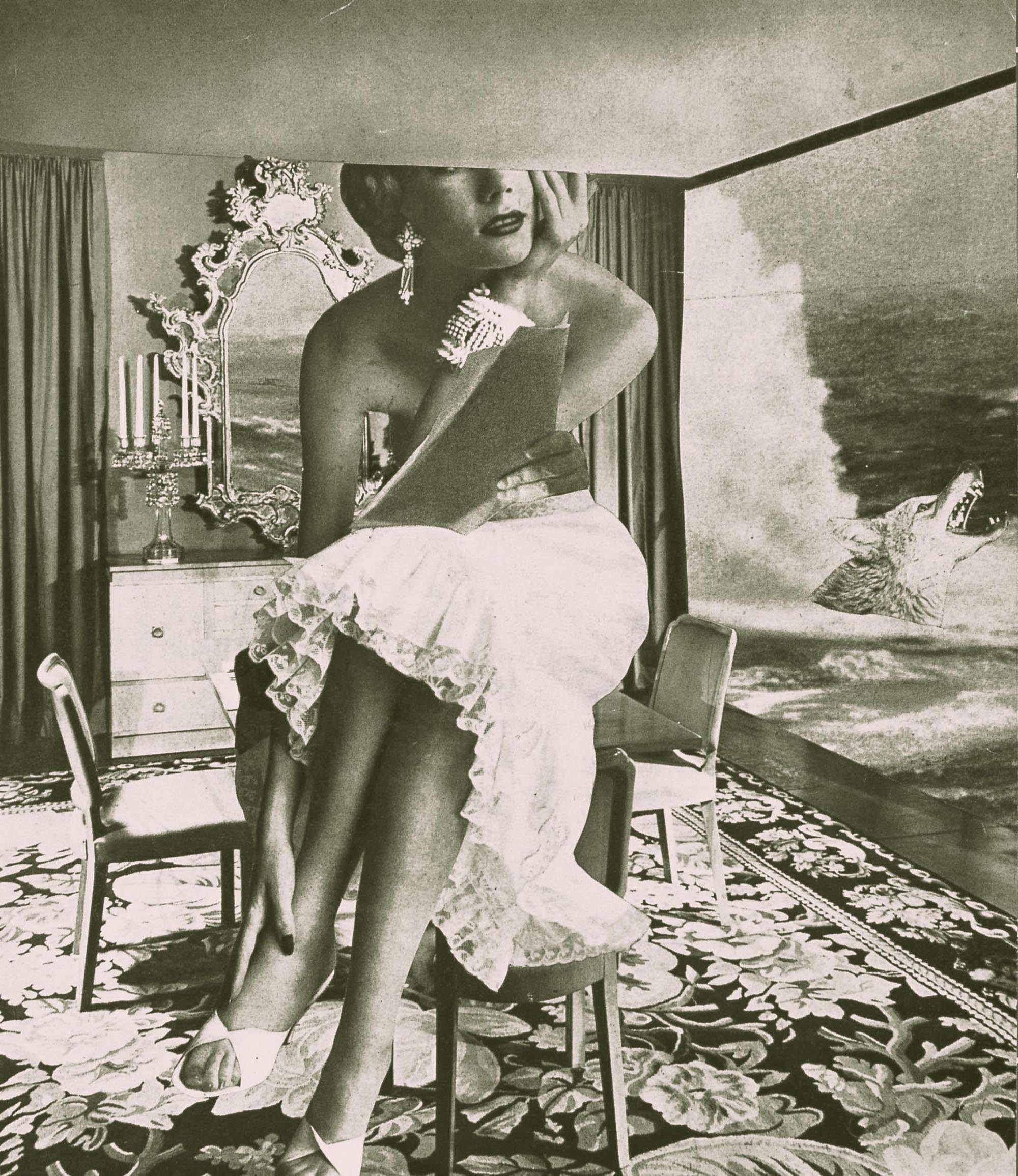
After becoming independently wealthy in large part because of the generosity of Cahun’s father, Moore and Cahun moved to Paris in 1922. The fact that they were stepsisters served as a cover for them to justify living together in Paris. There, Moore made portraits of artists, marketing materials, posters for theater productions, and designed costumes. Cahun wrote poems, essays, and prose for a variety of journals and magazines, often also for a theater publication of a company they were both members of; and Cahun continued to model for Moore. During this time, they joined anti-fascist organizations and created their second joint publication made up of photomontages, self-portraits, and collaborative collages called Aveux non avenus (Disavowed Confessions)—an illustrated book with 11 collotypes that Cahun referred to as an “anti-memoir” which parodied and critiqued the notion of a fixed self.

Claude Cahun, Marcel Moore, Entre nous (Between Us), 1926.
Gelatin silver print and pigment; 4 11/16 x 4 5/8 in. (11.9 x 11.7 cm).
San Francisco Museum of Modern Art, Gift of Robert Shapazian.
© Estate of Claude Cahun. Photograph: courtesy SFMOMA.
For many years, this work was erroneously attributed solely to Cahun as an experimental sequence of self-portraits. When in fact, it was made up of portraits of Cahun taken by Moore, that they together rearranged into a narrative sequence made up of collages, each titled: R. C. S. (fear), Moi-même (self-love), E. D. M. (sex), C. M. C. (vanity, sex), M. R. M. (sex), X. Y. Z. (lying), H. U. M. (fear), N. O. N. (greed, fear, self-pride), and I. O. U. (self-pride). In response to this project, Claude Cahun by themself wrote a text called Cancelled Confessions (or Disavowals), a 250 page “anti-memoir” composed of confessions “without deceit of any sort” about their own constantly evolving sense of self, made up of fragmented poetic prose. (This text includes the collotypes within it as well and was recently translated by Susan de Muth into English and published by Siglio Press.)
Theorists such as Lee Edelman and José Esteban Muñoz have posited that queer bodies in relationships can take on a paradigm they’ve called “narcissistic doubling.” When extended into the world of artmaking, this proposes that a queer artist’s collaboration with their partner might easily lead to conceiving of them not as a muse, but as a mirror of their respective selves. This, perhaps, is why Moore’s contributions to this project (which consists of collages of Cahun’s body made up of photographs taken by Moore) are so often dismissed. Because they were both queer, it’s as if Moore as a photographer is thought of as the person documenting the art: as an artisan, not an artist of it. Even though, in most other contexts, photographers are not so easily sidelined in the art world.
In 1937, Cahun and Moore left Paris for the island of Jersey where they began changing their names yet again to reflect their birth names; a retreat undoubtedly informed by the increasing violence of the Vichy government, as Cahun was Jewish. During World War II, they both ended up writing anonymous texts lampooning Nazis and mocking Hitler’s slogans that they distributed throughout the island: a kind of underground, covert queer zine.
As neither Moore nor Cahun were well-known when they were alive, the way they’re often discussed now is as “queer” and “nonbinary” and “trans” icons, as if an anachronistic label for their way of life could render them on par with contemporary polemical discourse on queer subjectivity. While their work certainly challenged notions of boundaries, of liberation, they are often rendered not quite human in the writings about them that come up, say, when searching for information on them in Google. This is why, throughout this essay, I’ve chosen to refer to both using “they” pronouns.
What can certainly be argued about their work is that it’s different from those made by both straight men and women in the Surrealist movement. Rather than portraying the self as other, Moore and Cahun rendered the self as a refractive collage of an objectified body in a hostile world.
On Abjection and Secrecy
For many years, no one knew about them. Their work was hidden in boxes in the island of Jersey, as if archived for some future researcher, but without any narcissism screaming for their discovery.
Stories in art history are populated by ones such as this one, which reminds those of us paying attention, that work by women, trans, and nonbinary artists are usually diminished, outright ignored by institutional arbiters of funds and critical attention. Or, alternatively, these artists make spellbinding work completely disconnected from the structures of the industry that their work could be exhibited in, purely because artmaking isn’t how they want to become famous. They don’t care about being famous, at all. In fact, being known would interfere in their particular form of play, the kind that produces images, ideas, sentences, feelings, that reduce the plasticity of surface-level thinking to appear as delicate as glass.
To be invisible to systems of domination is not so easy. Power, after all, often wants to surveil those it oppresses; in order to monitor possible insurgencies. Even if not in search of fame, all artists come into contact with galleries, encounters with people who inspire them, possible sources of income, and of course in the case of artists who make objects with their hands, those who create the materials by which they fashion their work into reality. Most artists who lived their lives invisible to those who consider themselves “in the know” — it’s impossible to know what motivated a life in the shadows.
Whether privacy, as I wrote in my essay on Hilma af Klint, was a source of freedom, of a space without judgment of her imaginative capacity. Whether war, in the case of Maruja Mallo, destroyed most of her art because the art usually selected to survive war are those made by men hung up in the salons of the bourgeoisie; who can afford to pay for it to be shipped to some other country before their owners, too, flee. Whether it was because an artist, like in the case of Leonora Carrington, lived and wrote in her adoptive country, but whose works often referenced her birthplace and so, finding those who would advocate for her particular creative voice weren’t easy to locate.
To be invisible to systems of domination is not so easy.
For those women artists, the forces that kept them secretive were also rooted in the insidious, inherited practice of servitude that so many women learn as children from the world around us, that so many of us are forced to unlearn as we get older: the pressure that asks us to subsume our own desires in the everyday labors of surviving in an orderless world run by careless men. But for some, like Marcel Moore and Claude Cahun, there was also a different dimension that inspired their choice to hide: not just their social conditioning to exist as women who they did not feel themselves to be, but their sexuality, the way they loved.
To be faithful to their eros, abjection was required.
Secrecy can always be a game.
The Construction of Genius
As someone who grew up spending more time in theaters than playgrounds, it’s been so clear how wrong it is; this notion that an artist is the sole genius responsible for a creation, that the individual is sacrosanct. Sure, it’s an easy lie to sell. Also, people do possess indelible personality traits, and their creativity, when channeled from their person, can emanate as if lit up from within. But this idea that a work of art, one with a point of view, a story arc, a character or more, and a form; that it could be conceived in isolation of everything else, everyone else, all of history and every previous conversation ever conceived of—is so obviously ludicrous.
We all need to eat, to move our bodies, to sleep, to work with materials we can’t always generate on our own or even build with our hands. Beyond that, ideas don’t swirl around in a vacuum—as David Lynch famously declared, “ideas are like fish” swimming around in a pool that we can all catch, a fish swimming in the waters that surround our shared world. We inherit ideas, nonconsensually. Where we’re born, who we’re in love with, where we eat dinner—it’s all an influence in our art. Maybe when someone sits down to write, they do it in a room where no one gets to enter unless they’ve been gifted a spare key. But even in isolation, ideas are borrowed, phrases are played with, friends are made use of as characters or as a narrative voice, occasionally even co-opted for the sake of tying together a larger motif.
In filmmaking, dance, and theater, where a group of people with different skillsets are required for anything to be made, it’s clear to me that any notion of “authorial voice” is a work of design, from the coming together of a number of people with an intention to produce a tone. In their jointly-authored book Tone, Sofia Samatar and Kate Zambreno write that, “Perhaps we can think of tone as a collective mood,” an act of “thinking through space” made up of the “us that is us and beyond us.” An implication that something is made only as a result of the “friction of rubbing against each other,” much like the artistic dynamics that Cahun and Moore experimented with, throughout their lives together until Cahun’s passing in 1954.
With art forms like sculpture, photography, poetry, it can be easier to identify one person as the creator of both the finished product and the ideas behind its design. But there are others, who are essential to its creation. In painting, those who make the paint, the canvases; the people who sit or model for an artist or if it’s a landscape, the wilds that continue beyond move irrespective of the artist’s desire for control over their subjects. Celia Paul, in her book Letters to Gwen John, writes about this, explores the impossibility of painting without collaboration, without the presence or energy of those being painted. Technique is simply a vessel. All of this to say, it’s impossible to solely attribute to one artist whatever about their work it is we personally find moving—what stands out to us emerges from a conversation between the viewer and the art, not necessarily an idea we can confirm as originated by the name or names attributed to a work.
We grow up in a world that doesn’t mirror our reflections back to us with dignity, it obscures how our desires move.
Beyond that lies the problem of the art market. Even if it’s run by people who also understand the notion that art is collaborative, most work made explicitly in that way is often silenced or considered “experimental.” Over and over, in order to sell any exhibition or book about artists, these famous men in history deemed “geniuses” are written about as if that fact is nonnegotiable. But how many people know, for instance, that Rodin never sculpted in marble, that his hands never made a single work we see attributed to him in a museum? He only used plaster or clay to propose what he wanted his assistants to create; the works we associate with him, in other words, were rarely ever in contact with his famous hands. What is so important about hiding this lie from the public? Perhaps it’s shame from curators that millions of dollars are invested in upholding this notion of Rodin as a kind of god of modern sculpture, as if no one else was creating work while he was alive (which is, of course, not true—one need only look at the life and work and ethos of Camille Claudel to be contradicted of this falsehood). Or, maybe, people with power simply don’t care to document the names of those in history who only appear as “assistants” who, more often than not, function as sources from which to extract underpaid labor, and therefore, too stained to write into legend. Perhaps curators are naïve, inconsiderate of the possibility that art history rarely challenges the credibility of its own subjects.
But, it must, at least sometimes, be deliberate.
This suspicion of mine also grows, when confronted with the work of queer artists. Many of us tend to be more explicit about our influences, as so often our art is made in direct contradiction with most other subjects previously captured in art. We grow up in a world that doesn’t mirror our reflections back to us with dignity, it obscures how our desires move. And so, it feels not just natural but a dare, to reject this notion of a singular genius and instead, collaborate with our friends, our partners, our family—to make what we wish to make.
Claude Cahun and Marcel Moore, in their collaborations, function as a doubling of each other as both artist and muse, subject and object, material and producer. Despite the plethora of evidence that they made pretty much everything together, Cahun is much more well-known. They are considered the genius, Moore the servant, the assistant, the one who’s less-relevant. This characterization from a patriarchal art world harms all of us—not just our ideas of Moore, but the way in which we’ve decided to devalue the role of the person who might not be as extroverted as their partner, not as much of an attention-seeker. It doesn’t mean that they weren’t ambitious, that they didn’t make work—in fact, it usually means they’re more interested in the work, less in selling it.
The Desire for a Self
Collaboration can be dangerous.
The fear of not being able to return to myself, the fear of losing me, haunts me incessantly. Who I am, who I’ve built myself to become, feels so hard-won that I don’t want to let it go. And yet, I do. All the time: when I don’t follow through on a promise to myself, when I don’t go to a park during the week, when I don’t wake up early, when I forget to journal for two weeks. When I don’t, when I don’t, when I don’t—it’s easy to become subsumed by my own negativity, when paying attention to the positive attributes of another. It’s the part of being in a relationship that’s always been most difficult to me, the frequency of self-abjection in the face of another’s interests, pursuits, desires, spaces.
I like mine.
But I’m also easily distracted. In earlier moments of my life, I sought it out: the experience of being consumed. Of feeling myself dissipate, spongify, coagulate into some other version of who I could be when in proximity to a person with an energy distinctly different from my own. But now, I try to be a little more careful, a little more trusting that who I am can’t be so easily abandoned.
“Doubling” implies that when an object or person is replicated, they will be multiplied, not reduced. To ask a partner, whether romantic or artistic, to become one’s own mirror, a fixed object to reflect a warped image back—requires a trust in the incompleteness of whatever will be revealed in the image created by one’s own partner, by the self’s unfixed nature as seen by another’s gaze. In other words, self-belief is an anchor that needs to be strong enough to resist the pull of an echo to abandon one’s own roots and commit to a surface of it.
And yet.
Even if presented as a complete person, everyone is a collection of fragments—body parts, ideas, or feelings. Split apart, recontextualized, repeated, doubled, inverted. Cancelled Confessions (or Disavowals) is composed of such ruins, as Cahun’s text is constructed almost as if they’re directions to the reader for what might be possible in their life, as opposed to a more full-scale descriptive portrait of their life and identity. The collages, similarly, are composite ideas made up of rearranged disruptions. Together, the photomontages and the text are in conversation with each other.
Orifices speak. Because text cannot always describe images and vice versa, they cannot serve as explanations or justifications. Rather, each is the evidence of the process of its own becoming, accompanied, stained, contaminated, enraptured, complicit, and engulfed, by the presence of another. In Cancelled Confessions (or Disavowals), a photomontage is an essay, the text is a collage, and this doubling between the two art forms mirrors that of the doubling happening within the creation of both of them—Cahun’s body and self is being infinitely repurposed. Moore took images of Cahun in a range of costumes, looks, gender presentations; then spliced them up and placed them within a frame of a tone, narrative, and point of view. Cahun then wrote about what is happening within themself when glancing at these reconfigured images of their own body; the memories it brings up about their childhood, their romantic relationship, their ideas about art—also ones that were influenced by their partner’s perception of those recollections. That, then, informed the presentation of the collages into a certain order. There’s a constant distorted replication effect—the kind of image created when one looks into a mirror while there’s another mirror behind.
A momentary unfurling of an infinite sequence of reflections.
A portrait, shattered, as smooth as cracked glass.
Like some trick played on us by the past, so often I’ve been taught to think that art like that, one full of holes, was a portrait of resistance but not of artistic genius. But maybe it’s making its own code, and Genius is too slow to catch up.
Featured image: Claude Cahun, self portrait wearing a shirt inscribed “I AM IN TRAINING DON’T KISS ME,” circa 1920s.