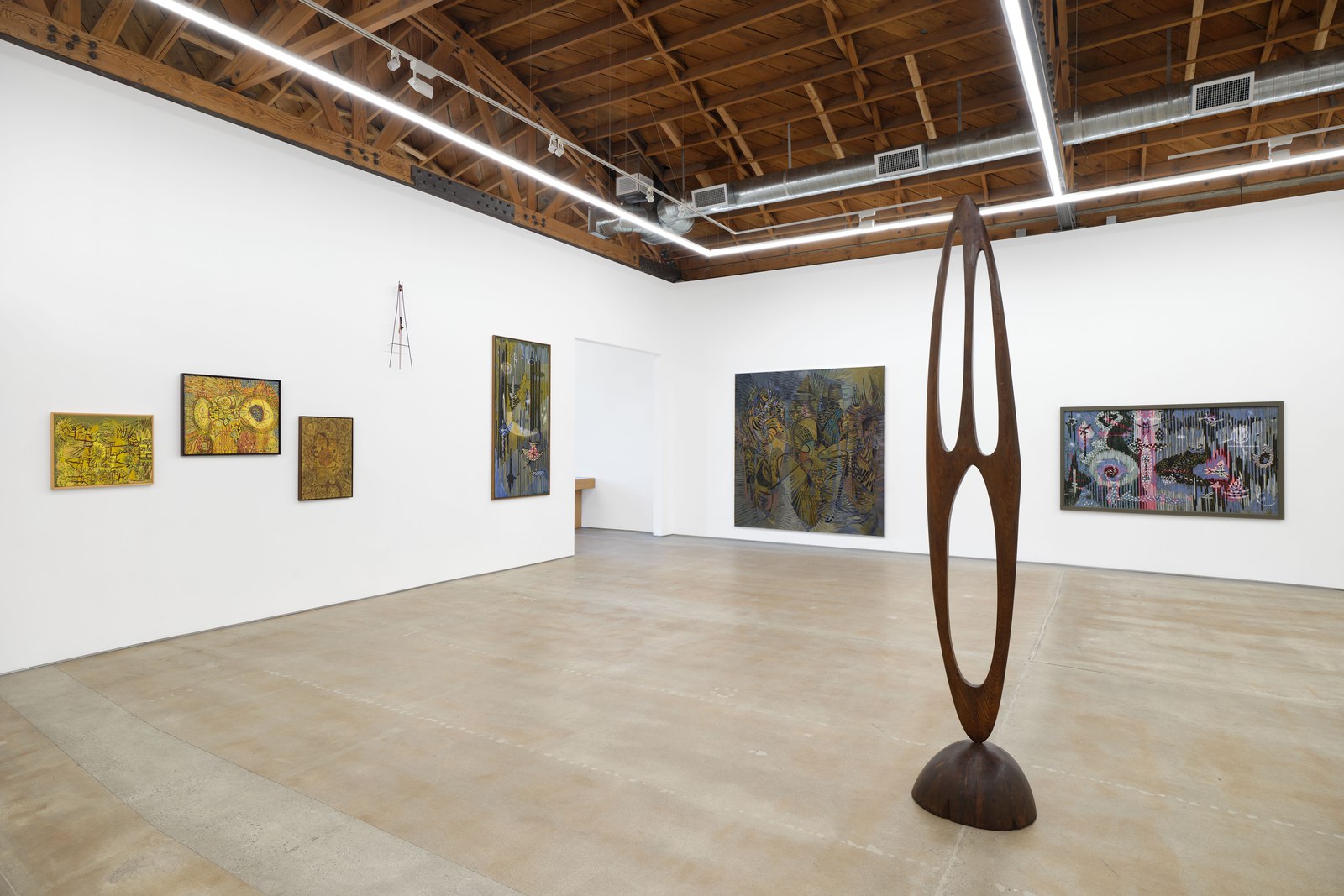
Toshiko Okanoue: Home in an Age of Fragmentation
“I always forget,” my girlfriend said recently after a relaxing afternoon, “that life is supposed to be about pleasure.” I instantly disagreed. “I never forget,” I declared confidently. She looked at me in disbelief. “I never forget,” I repeated, considering how to phrase what I mean, “which is why when I don’t feel it, I can find it so upsetting.” She looked surprised by that, but understood what I meant—and it’s true. Recently in particular, I’ve found it upsetting how distant I’ve become from it, how little I access it in my everyday.
As if my head is separate from my body and only my head is necessary. As if my body is elusive, almost irrelevant. Strange, how much effort it takes to convince myself—through stretching, journaling, walking, etc—that my head is, in fact, connected to my body. How odd. Maybe it’s a result of the frequent tactics of disassociation that pepper interactions, the kind that emerge when I just can’t navigate a day in Spanish anymore. When I can’t figure out how to describe my feelings accurately. When I can’t figure out how to say what I mean and to have patience.
Drained, I float—disassociated—a phantom.
On the Psychological Definition of Headlessness
Headlessness, in psychological terms, refers to the realization that everything observed is contained within the contents of one’s consciousness, rather than separate from it. What is seen, heard, touched, is nothing more than an appearance of one’s consciousness—headlessness refers to the act of experiencing, even as far as visualizing, this revelation.
The sensation itself is kaleidoscopic in nature—psychedelic.
Since one is witness to the presence of one’s head, consciousness is identified as something that, therefore, transcends from the head. “Having no head” can be akin to experiencing the arrival of a shapeless consciousness, where considerations, contradictions, move within a fluid orbit. “Having a head,” in contrast, is the act of experiencing said thoughts—the same ones that were “headlessly” experienced as floating in a kind of formless, ambient universe—as though they’ve simply arisen “naturally.” In other words, to “have a head” means the mechanism that conceives of thoughts and perceptions, does not present itself as a crucial part of the fact of experiencing anything. This all, of course, is connected to the movement of subjective, first person experience. We usually think of ourselves as subjects, with what is outside of us as objects—unless, of course, we’ve deconstructed our relationship to said “things.”
Headlessness—this sensation of being out of one’s own body while also inside of it, observing it while also inhabiting it—is an experience that reveals how illusory the notion of an “object” as without a soul even is; they each also are contents of consciousness, too. Psychedelics can help expose this reality, even push this experience of self-witnessing-and-inhabitation as something that explodes out of one’s head.
Another way this reality can become obvious is through the experience of intense PTSD as a result of abuse, violence from war, the explosion of an atomic bomb, the repeated violence that occurs in a society where emotions are rarely expressed.
Let me start again.

The Museum of Art, Kochi
The Disappearance of Home
In conversation with a Russian friend of mine in Buenos Aires last week over drinks, I asked her, “when you hear Russian spoken, do you feel as if you’re farther from your home, or closer? Is there something in the language that nourishes you?” She leaned back for a second, confessed to a “no.” She’s a therapist after all, many of her clients still live in Russia and she works with them over Zoom. Besides, there’s a flourishing community of Russian-speakers in Buenos Aires anyway, those who fled the country before and after the invasion of Ukraine, for political or personal reasons.
When it’s a personal reason that instigated the flight, sometimes it’s because someone is queer and it’s illegal in Russia to be queer; another instigating factor may be because it’s difficult to have a social life, given that it’s illegal to gather in public spaces with more than three people at one time. Since the invasion of Ukraine in particular, it’s also become increasingly difficult to be in frequent contact with people outside of the country because phone service is monitored by the government and at any time, service lines can be cut.
And so, while I’d chosen the photomontage artist Toshiko Okanoue months ago as the next subject for an essay about women and the surrealist movement, it seems clear to me only now that she was going to exist over my head, floating above me like a ghost, until I learned to exist in the world using her tactic to grapple with hers.
For this friend, the decision was political in nature, but also about her livelihood. “After the invasion of Ukraine, I showed up with 300 hundred others in St. Petersburg to protest, expecting many, many more. But no one showed up. They arrested us and eventually, after we were released, I looked around.” She’s an activist as well as a therapist, and was, at the time, frequently protesting against Putin’s regime even before the war began: “I felt as if everyone had given into the dictatorship, it felt final.” In that moment, she realized it wasn’t her St. Petersburg anymore. “My home had disappeared into the past, it had become something else.” To be home and to not feel it to be a home, even if it looked the same. For the same walls, the same streets, the same buildings to be possessed by a different energy, one of defeat mixed with sorrow.
Burnout as a Result of Sorrow
For much of this last calendar year, I’ve been struggling with a crippling experience of burnout. Not necessarily a writing block, as I’ve heard others describe their own struggles with self-expression, but an emotional exhaustion that prevents me from being interested in sitting down and turning the world off in order to write. It’s the first time in my life that I’ve experienced this. In the past, I may have experienced a few days of exhaustion after the conclusion of an intense work project, or after a week full of working overtime at a desk; but after a few days, it soon passed. Not this year.
I’ve found it almost impossible to disappear into the shadows for the day, to melt into some edifice and write without interruption; much less, even come up with the desire to write. And so, while I’d chosen the photomontage artist Toshiko Okanoue months ago as the next subject for an essay about women and the surrealist movement, it seems clear to me only now that she was going to exist over my head, floating above me like a ghost, until I learned to exist in the world using her tactic to grapple with hers. I needed to lean on her creative practice in order to nurture me in the middle of a difficult time.
Okanoue made collages out of magazines left behind by the US soldiers who stayed after World War II to “stabilize”—in other words, colonize—Japan, until she got married at 28 (my age now), after which she gradually stopped making art. She is, in fact, still alive in 2026, but only in recent years has she received any acclaim for her work. The history of isolation and colonization in Japan is particularly fraught because of its position as an island country as well as its conscious refusal to educate its citizens about its own past, as well as apologize publicly, for all of its war crimes. What can someone from an island, a place that needs to build its own defenses against the borders of the sea in order to operate as a functioning society, offer others about how to grapple with trauma in an uncertain world?
After all, I do like to write as a form of collage. Rhythmic, direct, and idiosyncratic—arranged in layers. I might take some screenshots of an artist’s work I find online, then I do a little bit of digging about their background; I leave myself a voice note or two about how I feel in relation to something they seem to be exploring. I read more about them, what (if anything) other writers I admire have written about them, then write a little bit more in a stream-of-consciousness; then I might listen to some music, take a walk, jot down some notes when ideas emerge in moments when I’m not consciously trying to write.
I stay in the world of it without conceiving how the piece might be arranged, then take everything, transcribe what needs to be transcribed, put everything I’ve assembled into a new document, with the intention of ordering the details in a way that flows smoothly. It’s not always based on chronology, or theme, or energy; but usually, one of the three. Or, some kind of personal experience. I’m doing some of this for the one I’m now writing here about Toshiko Okanoue—who, of course, is the first person I’ll have written about so far for A Women’s Thing who is from Japan—the place where the other language (other than English), that I speak with the fluency of a person raised within its frame, is spoken.
Let me start again.
On the Exclusion of Women from Japanese Society
In Japan, the world of art (as well as power, politics, war, and social life) has long excluded women far beyond the ways in which European, as well as North and South American countries, have excluded them (I mention those regions specifically because they are where all of the other surrealists who I’ve written about thus far, were born). Many art forms in Japan also expressly bar women not just from participating—but observing—art. For hundreds of years now, there have been art practices in Japan dedicated expressly to men’s performances and explorations of femininity. In other words, while queer and trans performances by and for an audience of men have been permitted in Japan for generations, women don’t just face obstacles and are prohibited entirely from participation, but frequently objectified within the art forms they’re excluded from. Their express omission from certain spaces has meant that the art forms where they are often successful (such as writing, painting, photography, fashion and/or textile making, flower arranging, sculpture) are ones that, by and large, are solitary practices.
In and among this reality is a long tradition of collage-making as an art form in Japan, which women have long been a part of: hari-e and chigiri-e. “Hari-e (貼り絵)” is an art practice in Japan which means “pasted picture.” Typically using a traditional Japanese rice paper called “washi,” colored pieces of paper are posted on top of each other to create a larger image. These often can be incredibly layered and complex. Another collage art form, “Chigiri-e (ちぎり絵),” is a more specific category of hari-e where soft textured collages are created by layering strips of colored paper on top of each other, often depicting scenes of nature in a changing season. “Chigiri (ちぎり)” means “to tear,” and “e (絵)” is the word for “picture.” Japanese art forms often are focused on expressing a moment in nature in the midst of a shifting season (alongside formal constraints like syllabic count, it is the only other requirement for a haiku, for instance).
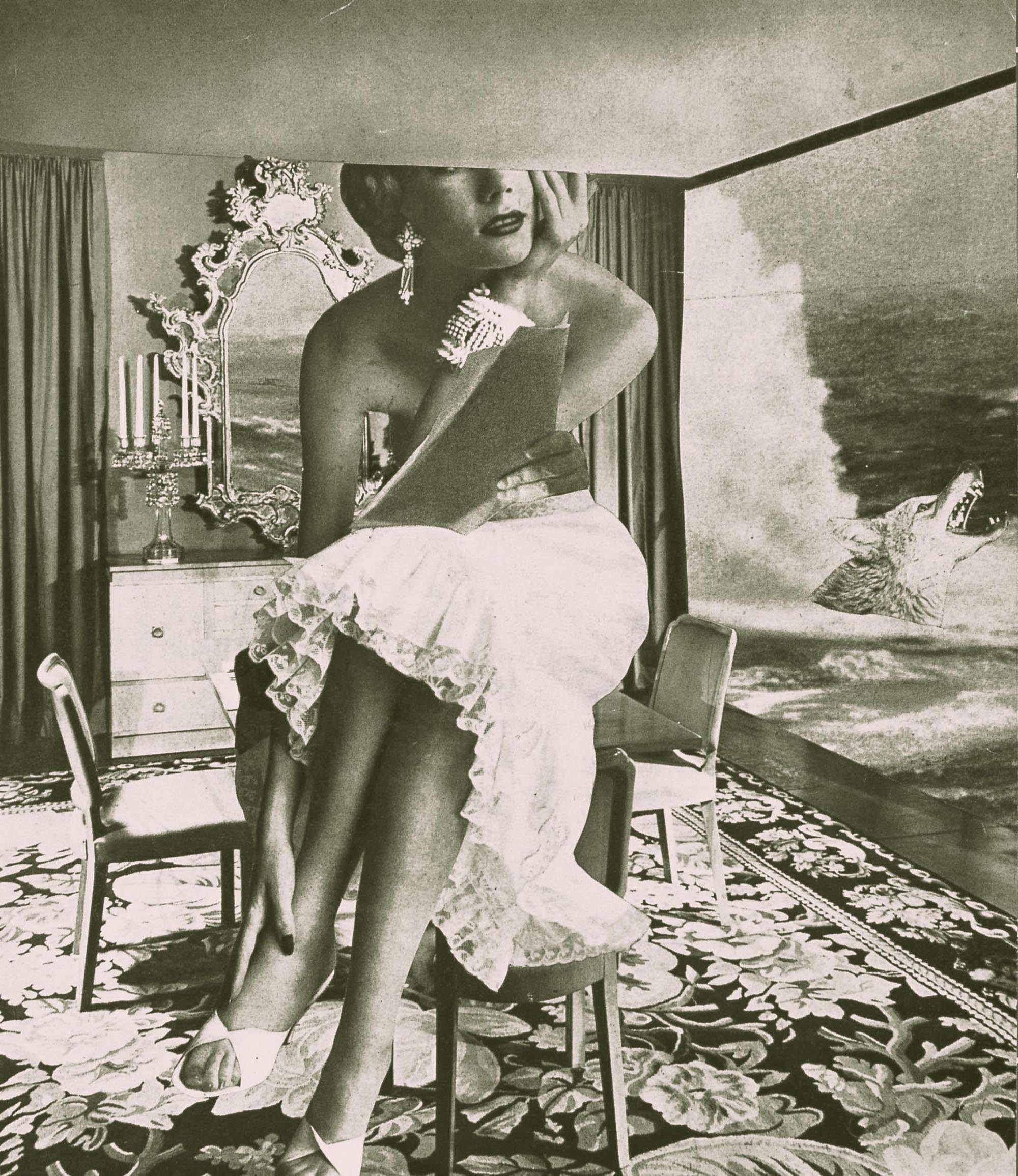
Okanoue’s photomontages can be seen as taking inspiration from this ancient artmaking practice in Japan. The difference between those collages and Okanoue’s, however, are that hers do not show their seams—the images she cuts and pastes on top of each other are not so visibly layered but instead, appear to be invisibly intertwined with each other. In other words, it is less textured, more illusory. What might be hidden in this evident display of placing women with a touch of glamor, at the center of seamless scenes of apocalyptic chaos, without their heads intact?
To find the way to articulate something in the clearest way possible. Try to be direct. Present something new, but in such a way that someone reading it will understand: pick this up, take a look at this way of seeing. Everything is an idea to cut up—attention will likely shift to some other point of focus soon.
What else to do with her time as a trained artist than to make, out of materials—of those who bombed, invaded, violated, and made her country into its own airbase—something other than wreckage? While Grete Stern in her photomontages often portrayed women in circumstances where their freedom of movement was constrained, Okanoue renders women’s bodies as by nature surreal, dream-like, full of holes, incomplete and incompatible with the movement of nature. Each is speaking of the existence of womanhood in the context of where they lived: Stern in Germany and Argentina, Okanoue in Japan. Both of them, in different ways, leave their viewers with an expression of how a witness of their work (specifically a woman, though not exclusively) might feel in the world without knowing it until that moment. In many ways, though they never met, their work can be seen as in conversation with the other.
Okanoue’s Protagonists in the Wreckage of War
In black and white, bodies spliced into fragments. Women, always. A white dress holding a cane in the middle of a forest surrounded by small dogs, with a parachute floating above in the trees from which a head hangs, a head with the mark of a red cross; behind this scene is a long line of other bodies, also headless. A cape hangs suspended in the air, an empty cape with flowers where the hood is, as a dog with a clock in the center of its body walks away. Another white dress, another body without a head but rather than a gaping hole, a white fan; she takes a step forward in the air, above a sea of umbrellas as tall, dark buildings loom behind her approach. Within a baroque room full of an elaborate chandelier, curtains covering a large window—a scene of chaos; a horse steps out from the mirror, a hand hangs from the chandelier, a horse walks to the fire place as on the ground, a woman in a white dress lays on her side with the head of a white horse as another horse approaches her from the large window.
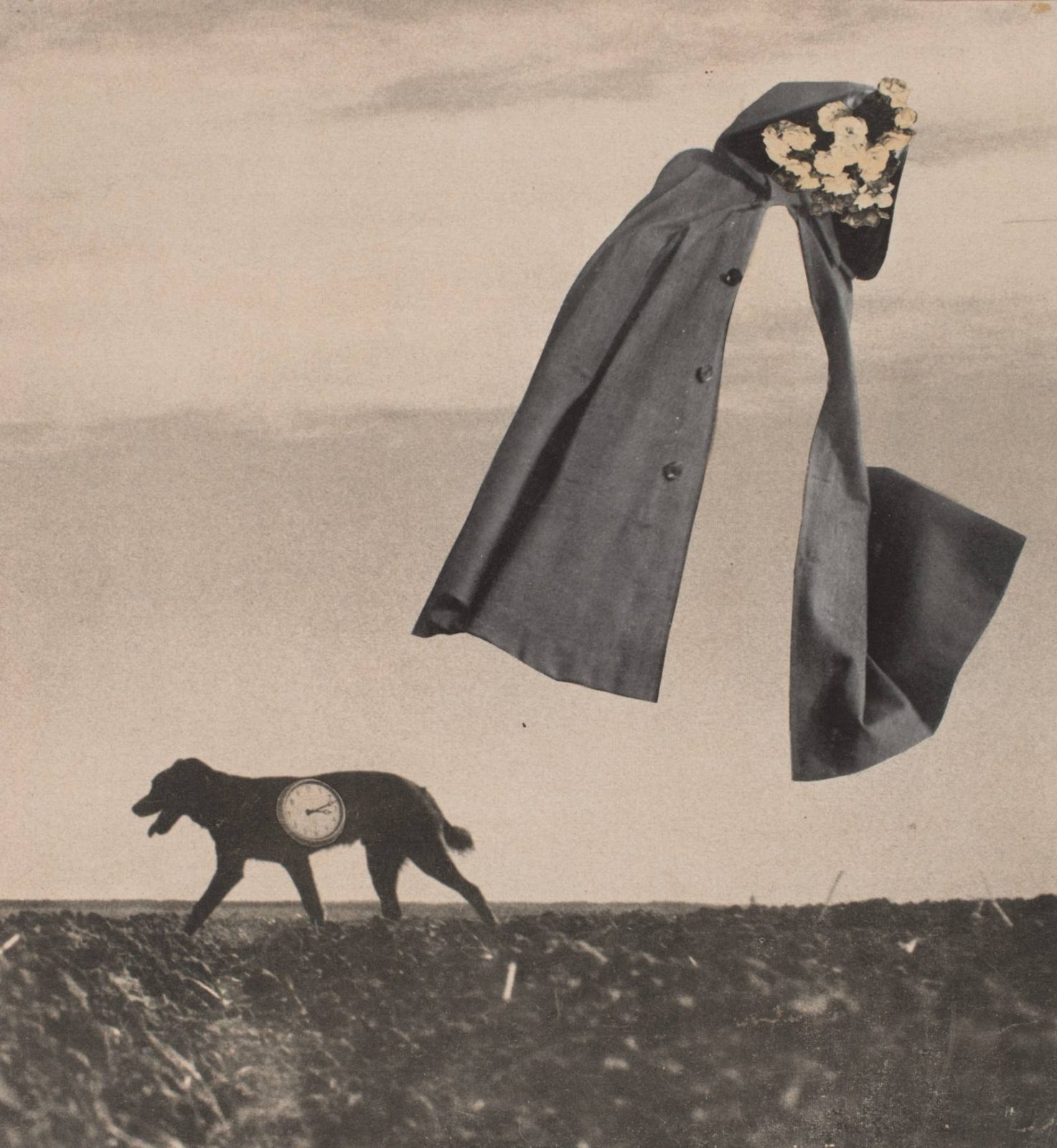
The Museum of Art, Kochi
A large white pitcher sits on the neck of a woman in a wedding dress, holding a white bouquet as she nearly falls out of an open window from which wind gushes out. A woman watches from behind a wall as war planes zoom across a sky, a sky visible from a platform with a table, a chair, and an open door. Another woman and where her head should be rests a number of weapons of war; she stands on the threshold of a door closed to her, in another white dress with a black slash of mourning. A giant hand holding a white bouquet emerges from a street as cats jump through the air and a woman looks up at this apparition; another woman, in another white dress, with clocks for eyes. Another woman in an expensive-looking room lies on a bed, with a cigarette in hand; but she’s trapped by a hand that emerges from a small piece of furniture as a man looks into the room from a mirror, watching her.
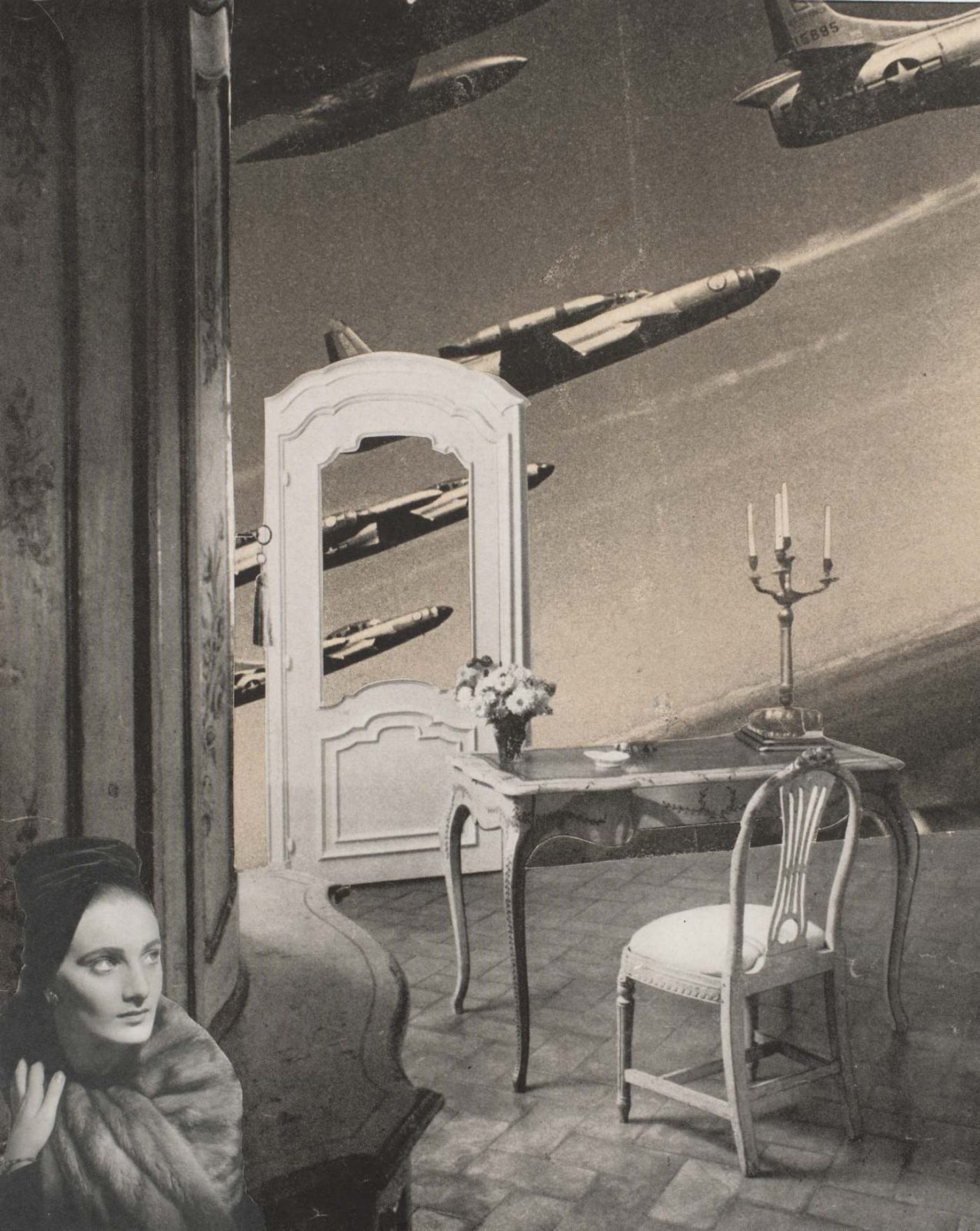
The Museum of Art, Kochi
Yet another woman in a white dress with only her mouth visible, sitting on top of a table, too big for a table with chairs, as the sea crashes on all sides, from the edge of the elaborate carpet to reflected from the mirror at the end of the room, as if there are no borders to separate inside from outside. A giant woman, another in white dress, with two fans on her head emerges from a torrential sea as onlooking gaze up at her, ambivalently. A woman, yet another walking across the skyline of a city with an elaborate bowl on her head, in a white dress with white gloves and a black bow of mourning, blinded as her hand melts, merges into her dress as a dog observes the space behind her, as if trying to protect her in the night. A row of tiny women in black dresses and ballet shoes (pointe) emerge from a picture frame to kick the shoulders of a much larger salary man, a businessman with machinery on his head who reads a letter from inside of a pristine office—is he deciding their fate?
Historical Context of Japan Before and After World War II
After many centuries of isolation from the rest of the world, Japan had industrialized at such a rapid pace at the end of the 19th century (called the “Meiji Period”) that they’d amassed enough technology to function as a colonizing force with the means and power to illegally occupy other countries. This was followed by a period before World War II when Japan invaded many countries in mainland Asia (including China, Korea, and even as far as parts of Russia), converting them to colonies of Japanese expansion. Many war crimes were committed at this time, which Japan has still not apologized for—this includes the extensive rape of women across occupied territories (particularly in South Korea and China), the Bataan death march in the Philippines (which resulted in approximately 3,500 deaths during the march and then almost 30,000 deaths due to starvation and disease in prison camps), the large-scale human experimentation and biological weapons research in mainland China by Unit 731 of the Japanese Imperial Army where over a quarter of a million Chinese citizens and prisoners of war died while and after being experimented on (alongside much smaller numbers of Korean, Soviet, and Mongolian prisoners of war).
The fact that in most of these collages, there’s a figure of a woman who is very clearly the subject of the montage and yet she has no head, no consciousness, no identifiable facial features—is blunt.
The horrors perpetrated by the Japanese were overshadowed in the history books (though not, of course, for the families and citizens of those who were victims of their violence) after the napalm-firebombings by the Allied Powers of some of the major cities of Japan including Tokyo, Nagoya, Kobe, and Osaka; and most famously, the atomic bombs that were dropped on the Japanese cities of Hiroshima and Nagasaki. After the Japanese army had perpetrated so much violence, their citizens became victims themselves.
Given the fact that Japanese citizens were largely unaware and uninformed of their army’s violence in other countries, the retribution of the Allied powers came as a shock; the sense of disbelief, that the country had been undeservedly punished, was and is still present within Japanese society (which frequently fails to reckon with their colonial past).
For thousands of years, Japan as a feudal state had been operating on the basis of a caste system that was built upon notions of honor, obedience, intense hierarchies, and allegiance, ultimately, to the emperor. When the end of the war occurred and the U.S. President Truman ordered Emperor Hirohito of Japan to command his citizens to surrender to their occupying enemy, this had been the first time his voice had ever been recorded and disseminated; in other words, it revealed Emperor Hirohito as a normal, common, person. This symbolically ruptured many facets and rituals of Japanese society.
However, very little reckoning with this action occurred because after the end of the war, the country rebuilt itself under the watch of Truman. This long-standing occupation throughout Japan of soldiers from the United States who unilaterally had invaded (most with little knowledge of Japan or Japanese) soon took over the government with the aim of entirely restructuring the society; in fact, the U.S. rewrote the Japanese constitution entirely into its own image, at this time.
Many cities in Japan had been burned to the ground as a result of firebombing campaigns from the Allied Powers, in addition to the destruction wrought by the two atomic bombs on Hiroshima and Nagasaki; all exacerbated by the fact that at that point, Japan’s buildings were largely constructed out of wood. Only Kyoto (the old capital of the country) had been spared, given that it had been identified as historically “worth preserving.” Almost all of Tokyo, as well as many other major cities across the country, were totally destroyed. Alongside widespread poverty, the 50s in Japan was an era of intense reconstruction, widespread despair about the future, and a complete disfiguration of national identity.
This is the era when Okanoue was most artistically productive.
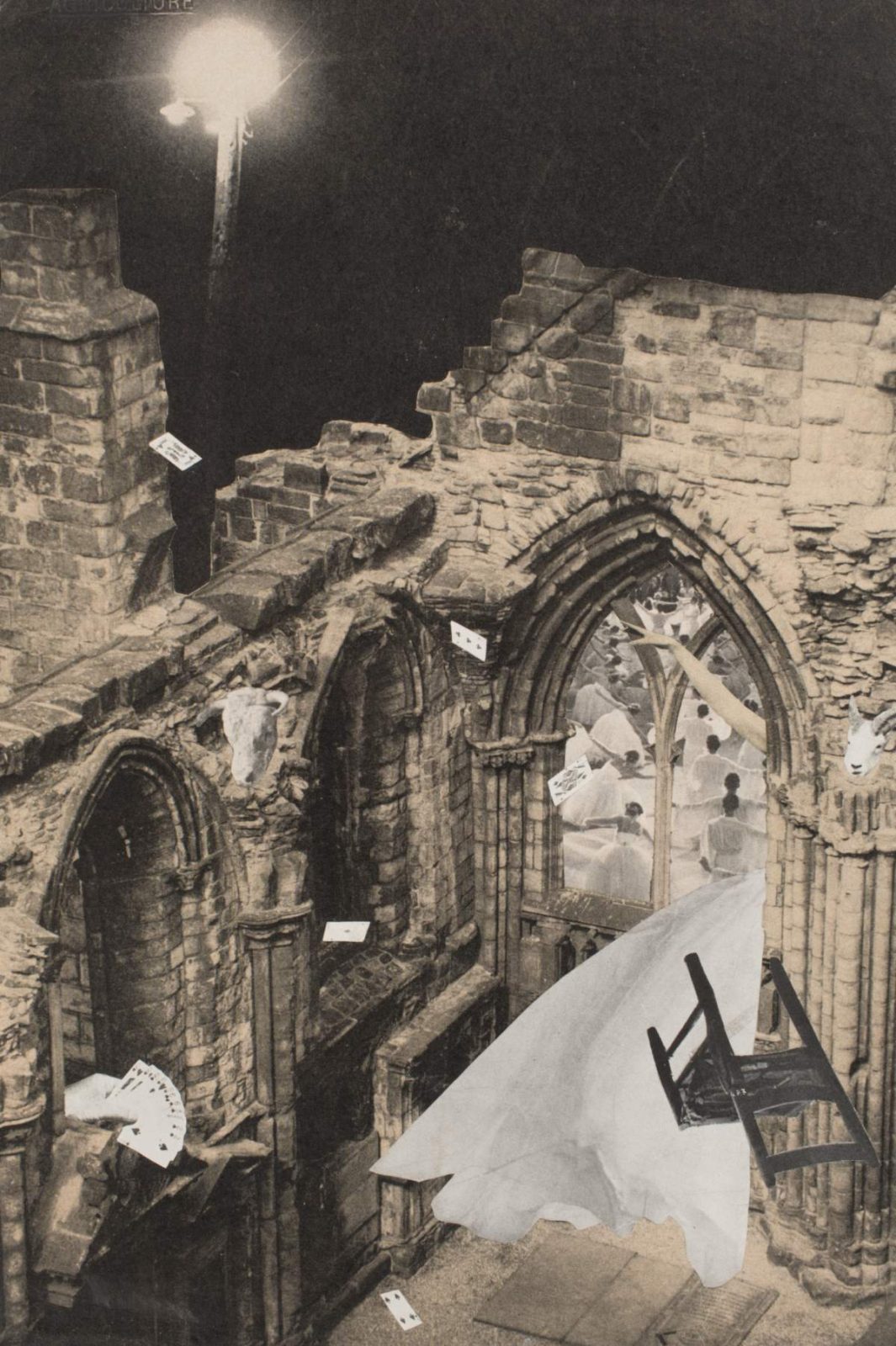
The Museum of Art, Kochi
These photomontages were constructed entirely out of these magazines left behind from soldiers who were wandering around her country, rewriting her country, reframing her country in their own image. Japanese people are a people of pride and of subtlety and reserve. The fact that in most of these collages, there’s a figure of a woman who is very clearly the subject of the montage and yet she has no head, no consciousness, no identifiable facial features—is blunt. Perhaps this is a commentary on the very patriarchal and hierarchical society in Japan where women are to be seen but not heard; people who are forced to be silent typically, but now doubly silenced by a Western imperial power (the United States) invading and imposing their cultural norms onto others.
Again, it’s important to note that Japan also invaded and violated people from other countries too; it is by no means innocent of impositions of colonial violence. Okanoue, however, was a Japanese woman who by all accounts and purposes had not left Japan when she started making these photomontages. There’s a contradiction at play here, between her identity as someone of both an formerly occupying and now occupied country; a woman with little autonomy, someone trained in art in a country that still excludes women from many facets of it. She made her work out of found scraps; cutting it up, reframing it into a new perspective.
Is this an act of resistance against material itself—turned into a form of repair reflective of inner turmoil?
Home Beyond the Walls of Home
I miss the sun, the feeling of it as I smell the Pacific Ocean. The way it’s more auburn there, while in Buenos Aires, the Atlantic’s sharper. I’m craving the softness of somewhere familiar, somewhere outside of this sensation of a hamster on a wheel I didn’t even realize I was spinning on. Conversations come and go, but this feeling stays: a yearning to belong to my own body. How long it takes to get there, I don’t like to confess. After years, years of understanding that the programming inside is twisted. Except if I hear Japanese, it washes away.
To be home and to not feel at home—when has that ever felt familiar? Always.
As if for a moment, I’m totally inside of something—a sonic landscape—where my brain feels at ease. Until, soon after, I remember what I am inside of it—an outsider. My first language, within which I first went to school, where I went to museums and read books and learned about history—the sanitized kind where World War II is taught as if it spontaneously began with the bombing of Pearl Harbor. That worldview from where my subjectivity emerged, the one I had to unlearn when I left the country at fifteen. To be home and to not feel at home—when has that ever felt familiar? Always.
Toshiko Okanoue’s Biography
Born in Kochi Prefecture in 1928, Toshiko Okanoue moved with her family to Tokyo at the age of three. She learned how to make her own clothing while she was still young. At this time, Japanese women were increasingly wearing Western-style clothing, but more traditional dress was also still widely worn. In the capital, Okanoue developed an interest in Western fashion by looking at Harper’s Bazaar and Vogue, magazines that had been brought into the country by U.S. soldiers during World War II. At the age of seventeen, she was also witness to the massive raids on Tokyo that occurred in May of 1945, including the extensive firebombing of Tokyo when over 100,000 civilians were killed by napalm. This experience no doubt contributed to her extensive documentation of catastrophe and continuous exploration of bodily disfigurement that can be observed in all of her future work.
At the age of 22, she enrolled in a school called Bunka Gakuin to study art. She studied chigiri-e at school and one day, noticing a cutout of a woman’s head among the scraps on the table, was inspired to add additional images from women’s magazines and glue them together into a composition. Around this time, she met Shūzo Takiguchi, a poet, art critic, and artist who was involved in the Japanese avant-garde and particularly, bringing the work of the surrealists to Japan. Takiguchi introduced Okanoue to the work of Max Ernst and this led her to evolve her relatively simple photomontages to more complex collages that used photographs for the backgrounds as well (previously, most of her compositions used a red or black single-color background). After working more on developing her own style, Okanoue had two solo exhibitions, put together by Takiguchi; one in 1953 and the other in 1956. After her first solo exhibition, she began to experiment in photography as well as continued to develop her photomontage technique but after getting married, she began dedicating less and less time to her art. Following her divorce from her husband, she moved back.
She still lives in Kochi to this day, at the age of 98.
Featured image: ©︎ OKANOUE Toshiko, The Call, Courtesy of The Third Gallery Aya