On Grete Stern: Behind the Eye of the Camera

In black and white, bodies spliced into fragments. Women, often. Usually. A paintbrush held by a hand, pointed towards a surface upon which the photograph of a woman extends, up. Another woman in a tailored jacket and long skirt stands on sand, leaning back in shock; as a train with the head of a snake and two eggs in its mouth twists over the ocean, barreling in her direction. Yet another in the attire of a 1950s housewife, with hands clasped in thanks, though maybe in prayer (and how different are they, really?) as she looks at a cracked, empty bird’s egg, twice her size.
Searching for some way that my subjectivity can be a vessel through which that image of someone else can become more clear, more specific, more concrete—more visible as their variable self.
In Search of an Artistic Voice
Mine for as long as I can remember, without asking for it in the first place. Friction, that could be the origin point for it. Easy to identify. A supposition for the sensation of its unease. But recently, conviction’s evaded me. As if the energy of a passion for something, it’s a lick whose flavor I’m only occasionally tasting.
But maybe I’ve found myself in the wrong context.
Mapping out a person: noting when and where they were born, its context, how they embraced it and left it behind—the texture of what they make of the time given to them, how it’s imprinted onto a surface (with language, colors, forms, their own body) and all of the tangents in between; but words don’t feel like enough. Not completely. Searching for some way that my subjectivity can be a vessel through which that image of someone else can become more clear, more specific, more concrete—more visible as their variable self.
In his essay collection Suppose a Sentence, Brian Dillon writes of the influence of photography on Thomas De Quincey’s imagination, “That mind is like a camera, albeit a camera that cannot yet make permanent the images that appear there. Except: for De Quincey they are permanent…” What motivates me to continue this exercise of mining the lives of unconventional women is predicated on trying to write out a picture of many photographs, archival fragments, art of theirs that live in my mind, each of them; as if an essay is a polaroid of a collection of highlights from a museum exhibition.
I’m attempting to hold many (perhaps contrasting) images in my mind at once, their arrangement an indication of how their way of being intersects, or doesn’t, with mine.
On Negatives and Positives in Photography
The object that is created when a photograph is taken—the record of the light captured over the course of a period of time—is called a negative. What we all recognize as a “photograph,” an object that resembles the way in which we see the world, is in fact the mirror-image of the negative—called, in technical terms, a positive (even though it is the secondary image).
In other words, what we label through language as the neutral image, the positive, is in fact in photography—an inverse of it.
Of our way of seeing, we too often want the world to reflect it back to us, even if our perspective is stilted or uninformed, factually incorrect or nostalgic, even prejudiced.
When we usually label something as a “positive,” its connotation is that it exists as the originary source, the object created as a result of an action. After taking away technical elements, manipulating said object, deconstructing it into its parts, we tend to consider its result as “less than” the originally intact object, thing, or person.
But this notion that photography is constructed with a negative first, and the image that is created initially using the tool of a camera (which captures light within a sequence of space and time), a negative but should be called a positive, is, I think, oddly revealing about how much we like to see evidence of our perspective—rather than consider that of another person, tool, or system. Of our way of seeing, we too often want the world to reflect it back to us, even if our perspective is stilted or uninformed, factually incorrect or nostalgic, even prejudiced.
Why is it that in photography, what began as an art form meant to capture the ephemerality of life in a single instant (as opposed to represent it in our own image as so often its function’s become), we’ve chosen to assign language to it that values our perception of it rather than its own internal mechanism?
Narcissism, maybe.
On Grete Stern
Born in Elberfeld, Germany in 1904, Grete Stern was raised in a Jewish household that spoke both German and English. While in university, she dropped out of a graphic arts program in 1926 and moved to Berlin in order to become a student of Walter Peterhans: well-known for teaching how beauty is constructed in the mind (using the theories of Kant, Plato, and Pythagoras) and how it can be translated into making art. I’m not aware of how exactly she became Peterhans’ student, but for a number of years she received private tutelage from him, before his appointment at the Bauhaus.

“Komol,”
1931.
Copyright Grete Stern Archive.
Courtesy of Jorge Mara – La Ruche Gallery.
At that point, she purchased all of his equipment and subsequently opened a photography studio ringl+pit with her close friend, Ellen Rosenberg Auerbach. The studio is an amalgamation of their respective childhood nicknames (Ringl for Grete and Pit for Ellen). Specializing in making prints for advertising companies as well as humorous portraits for patrons of their studio, they soon gained recognition in 1933 when their poster Komol received the first prize in the second International Exhibition of Photography and Cinema. A poster which depicted the profile of a mannikin with dark hair at the top of its head and white-blonde at its bottom, it is propped up against a concrete wall and behind a screen made out of metal, or tightly woven fabric; two small bottles are on the ground beneath the chin, and “KOMOL” is spelled out in the upper left corner of the print, as if the title of a poster itself.

“Columbus’s Egg,”
1930.
Copyright Grete Stern Archive.
Courtesy of Jorge Mara – La Ruche Gallery.
Successful at attracting a steady stream of clients, Stern also met the Argentinian photographer Horacio Coppola in her studio; with whom she soon fell in love. Her mother committed suicide in 1933, in complete distress at the rise of anti-Semitism. A year or so later, Stern and Coppola fled Nazi Germany for England for two years before settling permanently in Argentina in 1936. While in England, she took some of her most celebrated portraits (primarily of the exiled German intelligentsia), but it was in Argentina where she eventually set up a studio with her husband that specialized in producing experimental prints, works of graphic design, and popular surrealist photography that transformed the magazine culture of the Buenos Aires avant-grade.
She often collaborated with the renowned magazine Sur in Argentina and her first solo show was in 1943. Between 1948 and 1952, she made photomontages on a weekly basis for Idilio, a psychology magazine for women. In 1975, her first photographic exhibition was held in Germany, at the Bauhaus-Archiv in Berlin. In 2015 almost twenty years after her death, the Museum of Modern Art in New York (MoMA) presented the retrospective exhibition, “From Bauhaus to Buenos Aires: Grete Stern and Horacio Coppola.”
While celebrated internationally for her artistic ingenuity and singular voice, there have been very few exhibitions on Grete Stern’s work, and there currently exists no single book dedicated to her or her oeuvre in English. In fact, the only book dedicated to her work that appears in English is the text published to accompany the first US museum exhibition of her work, “From Bauhaus to Buenos Aires,” which also featured the work of her husband. Surrealism, which began with the publication of André Breton’s essay “Manifesto of Surrealism” in 1924, and the establishment of the magazine Minotaure, has persisted for decades at the forefront of popular and intellectual culture. With its niche forays into psychoanalysis and Marxism, artists from Egypt to Martinique, Japan to Mexico have all claimed to be inheritors of its tradition. While there are a range of novels, works of theory, poetry, and other statements from artists ranging from Diego Rivera to Jorge Luis Borges about Stern’s compelling work, very few homages to the women like her who participated in and expanded on the concerns of its movement exist today. Museums and art publications often feature Stern’s work briefly, as if her work is an asterisk, as if her output was limited. That is not the case, even though for English speakers, there is little evidence of it.
So often we want to hold onto our inherited worldview, even if our justification for it is much more complex than reality.
Many people will surely recognize her work, without prior awareness of Stern as its artist. If not, they’ll see in her work an exploration of questions that were eventually taken up by artists across the Americas and beyond in the following decades: the fragmentation of a self as a result of the multidimensional pressures of femininity and its restriction on the autonomy of women in patriarchal contexts.
The Limitations of the Eye
So often we want to hold onto our inherited worldview, even if our justification for it is much more complex than reality. The thing about truth, is it just doesn’t always look the way we can recognize. The X-ray of the human body, for example: the first time someone took a look at it, what did they think? Denial, I imagine. It doesn’t resemble the way in which we curve, how our skin softens our outlines, the shape of our ears, or at least how we see them, usually. It doesn’t take away from the fact that we see how we see, we’re just built in rejection of the relative limitations of our own eyes. What is the utility then, in reminding ourselves that the process of seeing is accomplished by our brains lying to us?
Photography and Photoanalysis
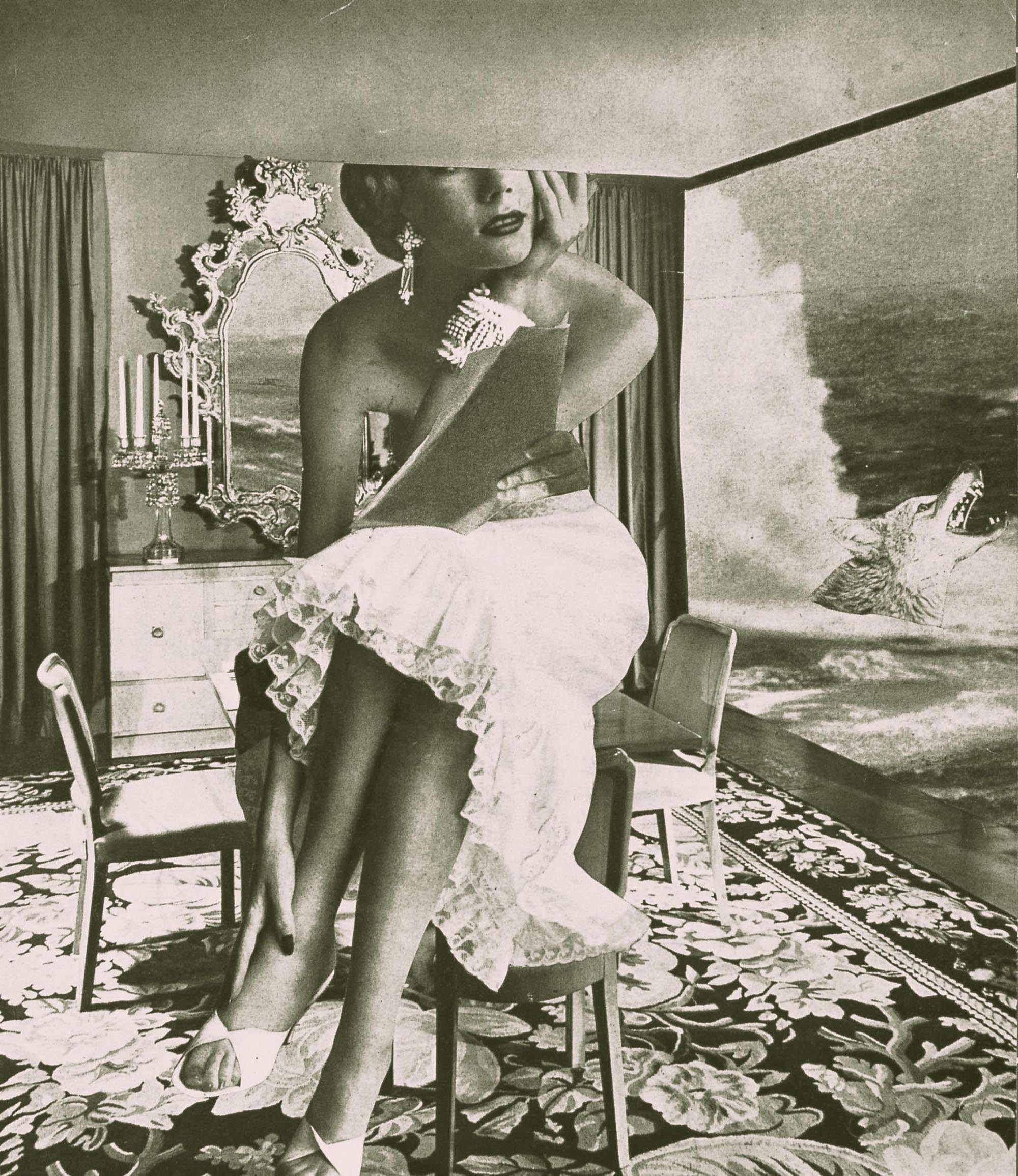
Stern is probably most famous in Argentina for illustrating the dreams of the readers of a women’s magazine in a column titled “El psicoanálisis le ayudará” (“Psychoanalysis will help you”). Thousands of readers sent in descriptions of their dreams, primarily nightmares featuring themes of anxiety, domination, and loss of control. Stern made, in total, a hundred and forty photomontages. Using her daughter and friends as models, she drew images of everyday objects in surreal contexts, or in unexpected dimensions. She once explained, “distorted perspective will always give the effect of insecurity.”
The intention of the column was to soothe the lives of its readers through a Q&A between the readers and a psychologist, accompanied by the photomontages. Stern took advantage of the constraints of the assignment to satirize the answers of counsel detailed in the magazine by usually depicting male authority as too dominant; rather than women’s desires as excessive, as the psychologist often counselled.
In black and white, bodies spliced into fragments. A paintbrush held by a hand, pointed towards a surface upon which the photograph of a woman extends, up. Another woman in a tailored jacket and long skirt stands on sand, leaning back in shock; as a train with the head of a snake and two eggs in its mouth twists over the ocean, barreling in her direction. Yet another in the attire of a 1950s housewife, with hands clasped in thanks, though maybe in prayer (and how different are they, really?) as she looks at a cracked, empty bird’s egg, twice her size.
Their choice in mentor seemed a self-invoked prediction of a kind of life they wanted to lead.
Stern understood that the trappings of femininity and liberation from its restrictions exist in the manipulation of aesthetics as the surface upon which to reveal, or conceal, an interior life. While not necessarily made with a gothic palate (as the pieces are less melancholic than ironic), themes of alienation, disfigurement, and self-doubt are woven throughout. By the time the column launched, she was also forty-four years old and divorced from Horacio Coppola.
Why Study Under Someone
When I would learn about artists of the past who, before they reached maturity, decided to follow some instinct within themselves to pursue a life path, I often noticed that they had received private tutelage from someone. Or, at least, mentioned the person they had studied under. Romantic, I always found it—picaresque. As if the selection of a singular teacher was a choice that cemented a detail in the narrative a person was creating in their journey to become an artist; almost as if they were a biographer of it before even beginning to live within its architecture. Their choice in mentor seemed a self-invoked prediction of a kind of life they wanted to lead, or maybe if not life, the kind of work they wanted to make, or if not work, access to information, tools, nourishment, funds, spaces, that they felt they needed to bring into their orbit.
I realized I could only be an artist, because I’ve always been someone who, for better or worse, is by nature rebellious after I observe the conditions of whatever context I’m inhabiting.
I’ve often found it slightly strange how few people wish to identify themselves as artists. It’s much more common for me to meet someone who introduces themselves as a painter or a poet; a categorization of their craft. Is it shame? Or a sense of impostor syndrome? Maybe the worry is that it feels too baroque. For me, to declare that I’m an artist never felt necessarily contingent on the work itself, whether or not I had evidence of it. Instead, it felt like a way to articulate the promise I made to myself that I would organize my life in order to make time for contemplation. For solitude. For meaning-making. Also, at some point I realized I could only be an artist, because I’ve always been someone who, for better or worse, is by nature rebellious after I observe the conditions of whatever context I’m inhabiting.
When I was at a crossroads at nineteen between continuing at the university I was enrolled in or going somewhere else, I decided to take a leap of faith and study performance studies at New York University. At the time, I was pretty ignorant about the history of most art forms (with the exception of theater), but sensed that by immersing myself in a world I didn’t quite understand, I could learn more tools about how to build and direct plays. While I had a fantastic experience, even after graduation, I didn’t feel as if my cup was full. That awareness of ignorance that I sensed before, an emptiness in my basis of knowledge, had returned. I needed to embark on a period of study. Not the kind where I would complete a worksheet or write an essay in line with the expectations of a professor, but a consistent practice of immersion in free association dictated by my curiosity.
Richard Schechner founded the field of performance studies: an experimental theater director, writer, editor, and scholar—an artist. He was running a developmental workshop for his next play in the building where I studied and I received the open call to audition for it in my inbox during my senior year, on a random day. I decided to participate as an actor (mostly in order to observe how he directed), and in the midst of developing the piece, COVID struck. The project never came to fruition, but I kept in touch with his assistant at the time.
About a year and half later, I reached out to her to see if there was a possibility of working together and she happened to be pregnant at the time. So, I started taking on more and more work for his disparate creative projects. For reasons not necessarily worth going into here, I decided a few months later that I wanted to move back to New York City and work for him as an apprentice. Or, at least, I thought of it that way (subsequently, I described myself as an assistant, a research associate, co-editor, etc).
He didn’t know I’d decided this, however. Without telling him or anyone else, I found a room to rent on Facebook Marketplace, bought a plane ticket, packed a couple of suitcases, and showed up at his office a week or so after I arrived back (I needed a few days to emotionally prepare myself for the possibility of rejection). I’d emailed him that I was in town, so he knew to expect me. Sitting across from him, I announced that I was his assistant now and would be working for him. Must confess, I’d maybe approach it slightly differently if I were to do it now, as I didn’t mention anything about payment (he did pay me, don’t worry) nor did I know anything about the massive projects he was embarking on for the rest of the year.
To my shock, he agreed without hesitation.
He didn’t even seem surprised.
A few weeks later when I asked him about it, he mentioned that this usually happens to him: someone (usually in their twenties but not always) shows up at his door, declares their intention to learn from him, and he understands that they’ll stay until they decide they’re ready to leave. This all felt thrillingly old fashioned and worked out well, but it was incredibly easy to imagine how the arrangement could devolve into manipulation, abuse—and worse. Despite the potential pitfalls, for about a year and half I became immersed in his archive, read all of his plays, most of his books, watched all of his footage of experimental theater from the fifties until now (some even earlier), until the point that I felt as if I understood the architecture of how he built his life in a way that was nourishing personally, nourishing creatively, and also provided a general sense of financial stability for him (even though, for someone who lives in New York City, he’s not necessarily that wealthy). I also learned that I didn’t need to replicate how he did it either—just that I needed to design my own system.
I realized working for (studying) him was a test to myself, for myself—to trust in my source of an artistic foundation, a niche, a universe from which I could unravel.
Those of us who feel ourselves to be artists may not necessarily be enrolled in the most prestigious programs or fellowships, or receive institutional demarcation that acknowledge us as “proper” artists. But all of us are able to select our teachers, who can be found anywhere. At the end of an email. A DM on Instagram. At a book release party. Walking through a museum. Even a taxi driver, they can temporarily be a teacher.
For Stern, it must’ve been much harder to identify Peterhans. To get in touch with him, to know how to find him. How did she manage to find the confidence to leave the legitimacy and social reward that a university degree would’ve offered her in Germany in the 1920s (when it was such an accomplishment for a woman to enter an arts school)?
I know, actually.
I know.

“Dream No. 35, Untitled,”
1949.
Copyright Grete Stern Archive.
Courtesy of Jorge Mara – La Ruche Gallery.
Some of Stern’s Subjects
Photomontages in black and white, bodies spliced into fragments.
Women, always.
In a white dress with flared sleeves, a woman stands on top of a globe of planet earth, floating through a starry sky, close to the sandy, rocky surface of an unnamed planet.
A mouth blurred out to invisibility on the face of a woman with an old landline phone held in her left hand, the right on her cheek—in shock.
Another woman with pearl earrings in the shape of a flower, with a ballet bun and in a crisp white button down shirt, probably in her thirties or forties; she holds up a small mirror with its edges blunted that reveals her fragmented reflection, but aged by more than forty years.

“Dream No. 1, Household Electrical Appliances,”
c. 1950.
Copyright Grete Stern Archive.
Courtesy of Jorge Mara – La Ruche Gallery.
Hands held up to her hair, the right one grazes the edge of a lampshade because her body is its support pole, tiny, and the hand of a man much larger in size is close to her body—as if she’s the switch to his light.
A woman in a white checkered shirt, a long dark skirt, dragging a giant rock up a mountain with rope, back bent.
Another woman stands in front of another mirror and while we see the back of her black hair, her face is only visible in the reflection of the glass, but its expression of horror is repeated so that on top of the reflection at her eye level, three more levitate as if held up by the fingers grazing its surface.
In Search of Seeing the Self
Famously beautiful, Narcissus was a boy who fell in love with his own reflection in the water while in flight from a girl, lingering by the shore of a river long enough to turn into a flower. This is a myth, of course. The oldest, most famous iteration of this story is recounted in the poet Ovid’s Metamorphoses, a collection of Greek myths. The character’s obsession with himself is recounted as a punishment for his indifference to the ardor that his beauty inspires in those around him. His rejection of Echo, a nymph, turns her voice disembodied. From the Middle Ages, recountings of the story frame this tale into a cautionary one; either about the dangers of mistaking an image for reality or about the dangers of pride. Unmistakably homoerotic, interpretations of the story account for Narcissus’ queerness either from his explicit rejection of women or from his sole erotic interest in the countenance of himself, a man.
An odd iteration of the myth exists as well, but only through hearsay. Conon reportedly wrote a version, but only a summary of it by Photius remains. Apparently in Conon’s version, Narcissus was very handsome yet repeatedly could never fall in love. No matter how many lovers he was with, he continued to be unmoved (in this version, he is also explicitly portrayed as gay). One of his lovers, Ameinias, kept insisting on love, yet Narcissus didn’t relent and sent him a sword instead. Ameinias killed himself at Narcissus’ doorway while he watched, and in the water of a spring nearby, Narcissus caught a glimpse of his own image—becoming his first and only true love. Unable to reconcile himself with the revelation that arrived to him in the midst of his lover’s death, Narcissus at a loss, thinking he was being punished for insulting Ameinias’ love, immediately killed himself too. The legend has it that the first narcissus flower emerged from the ground where Narcissus spilled his own blood. Selfishness should be punishable by death… apparently.
Regardless, the myth’s prominence in artistic discourse was awakened in the 20th century following Freud’s appropriation of it to embody a key concept of psychoanalysis. In his essay “On Narcissism: An Introduction,” he distinguishes between infantile primary narcissism and secondary narcissism, and the development of the ego as consisting in “a departure from primary narcissism” that “gives rise to a vigorous attempt to recover that state.” In later psychoanalytic theory, the myth reappears again as Jacques Lacan’s le stade du miroir (“the mirror image”) as the representation of insatiable desire, either of a human or of capitalistic society as a whole.
While most interpretations of the myth paint Narcissus as a villain, as the architect of his own demise, for writer André Gide, Narcissus represents the figure of the modern artist. Both the observer of her own work (work, as in, the cultivation of her own body of it) and the work itself, she (the artist) is the architect of how she reacts to her own reflections, her thoughts, her desires. How will she portray them, and, by extension, those that she receives from others in search of evidence of her interpretation?
How did Stern manage to find the confidence to leave contexts that didn’t suit her desires? From her university, to her country, to her marriage.
Maybe in her reflection lived a key.
Featured image:
Grete Stern, “Dream No. 7, Who Will It Be?,” 1949.
Copyright Grete Stern Archive.
Courtesy of Jorge Mara – La Ruche Gallery.